May 13, 2017

Living a Double Life as a Daughter of the Famous Panamanian Artist, Al Sprague

I am a forty something mother of three and a wife of a hospital administrator.  We live on a lake in a small North Carolina town.  If you met me today, you would never know that I grew up with a father who was so well respected in a small country the size of South Carolina because of his artistic talent. If you visited my home, you would begin to see the opening of a window into my past and you just might see a glimpse of my double life as a daughter of the famous Panamanian Artist, Al Sprague.

Growing up with a famous father was a life much different than many of my friends ever experienced.  The saying of my last name in Panama always brought on the question, "Are you related to the famous artist, Al Sprague?"  As a teenager, this statement brought the rolling of my eyes and a not-so excited answer of "Yes....."

In high school, I was ridiculed in geometry when I couldn't draw the shapes correctly on the blackboard with "Are you sure you are the daughter of artist Al Sprague?"

I laugh now when I think of this time in my life.  I had no idea of the uniqueness of my childhood. My every day life with my father provided me with the opportunity to stand on the sidelines watching how his artwork enhanced Panama's sense of pride in its culture, heritage, people, and natural resources.  How do you explain that to others who were not exposed to that?

In 2013 I stumbled onto an announcement on FaceBook that Memphis in May International Festival had chosen Panama as its country of honor for 2014.  My brain immediately went into overdrive and I knew I had to pitch the idea of my father being being part of this month-long festival in the city of my college alma mater.  I knew this would be a great opportunity to share my "other life".

What a joy it was to open a door for others to see a different side of my life.  Through this experience, I was reminded, once again, how important my father's artwork is to Panamanians, especially those who have migrated to the United States to live and raise their children. His work captures more than just a moment in time - it expresses a pride in a culture; a way of life; and of a country that is rich in its history and people.


Backstage after the Danilo Perez Jazz Concert

Artist Reception at Gallery with Panamanian Representatives and Memphis in May Representatives
I can't help but smile at the thought of living a double-life as a famous artist's daughter. My every day life has been filled with extraordinary experiences because of my father and his God-Given talent. Thank you dad ... I look forward to many more adventures and experiences in the future. 


A Love Story

I have always said that artists have a unique way of seeing things others just can't see.  They can express something on canvas which opens the eyes of others. 

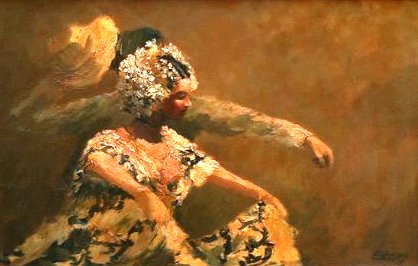
My father has done just that throughout his career.  In the early 1970's my father saw something in the way the light hit the templeques of the pollera dancers (the national folkloric dancers of Panama).  He saw the gracefulness in the way the dresses moved and most importantly he recognized the absolute beauty in the girls who wore the dresses with pride.  He had to open the window for everyone else to see what a beautiful tradition was right before our eyes. 


This early painting portrays the beauty of the polleras.  I first saw this painting on my father's easel in 1976 and told him how I loved it.  He promised it to me right there on the spot.  Today I wake every morning to the beauty of Panama as it hangs in my bedroom for me to enjoy.
Over the years, my father continued to paint the beautiful girls in their cherished dresses.  He spent many weekends at Old Panama taking photos of the dancers that he would use as material to produce these wonders.  An Al Sprague pollera became a "must have" for many in this small country.  He traveled the country to capture the many types of dresses and dances.  His favorite place, still today, is  the small village of Santa Domingo just past Las Tablas on the way to Pedasi.  He says the light is perfect and the dresses are the prettiest. 


"Galinda" is one of my father's paintings using the polleras from Santa Domingo.
Today my father's polleras hang proudly on walls of many across the world.  He has created a pride for many Panamanians for a tradition that may have gone unnoticed in the past.  This was best explained to a group of Panamanians during a show at the Panamanian Embassy in Washington D.C. when the Ambassador stated that it took an American artist to see and paint the essence of Panama for Panamanians to see the beauty of their country, people, and traditions.


"La Reina" is another painting of the beautiful dancer from Santa Domingo.

I guess one can say my father's career of painting Panama is a love story.  He fell in love with the people and the culture a long time ago.  And now, he continues to nurture that love through his art which opens our eyes daily to the beauty of a country and its people.  

August 4, 2013

Perfect Harmony in Art

Harmony has been defined as "a pleasing combination of elements as a whole".  It is something we all strive to accomplish in our lives ... may it be harmony with others or harmony within ourselves; we all seek to find that pleasing combination in all that we do in life.  I believe my father, Al Sprague, has found that pleasing combination in his world of art.

Pollera Oil painted in 2013


In the Beginning, my very first Blog entry,  I told the story of how my father discovered his talent and love for art.  After getting in trouble and not really knowing which way to go with his life, my grandmother, Josephine Sprague, sent him out with paint, a canvas, and an easel and told him not to return until he had completed a painting.  It was at this moment that my father discovered his passion for art but it would take years of painting, drawing, and sculpting to find and create harmony in his world.

Watercolor painted in 1969

My father describes art as something he has to do, it's almost like an addiction - He sees and he wants to create. There is rarely a day that goes by that he is not creating something.  Granted, sometimes it may be fishing lures or decorative rocks, but creating is just part of who he is.  It gives him a sense of wholeness; a sense of being; it is his harmony.

Bahamian Oil painted in 2008


Life hasn't always been easy for my father.  He has struggled with much in his lifetime.  Like many artists, he has  struggled with alcoholism and depression, but one thing has remained consistent - his love for art.

We, as admirers of his God-given talent, are the lucky ones.  We get to experience harmony by viewing his creations.  Viewing his work is like hearing a beautiful symphony playing on canvas. The colors, the composition, the light all play together and create a perfect snapshot of harmony.

I, though take it one step further - I see each piece of his work as a building block to creating harmony in my father as an individual.  It is the combination of his life creations that has made him into the artist we all know and love - a person who has found harmony in himself through the world of art.

April 5, 2013

Postmarked for Eternity


The 13 cent Canal Zone stamp was the first postage stamp published using my father's artwork.  Issued February 23, 1976, pictures the dipper dredge, Cascadas.  The Canal has always been a subject matter my father has embraced.  He created a drawing, etching, and painting of this composition. 


The original is part of a permanent collection owned by the ACP (Autoridad del Canal Panama) and was reproduced in the widely distributed Panama Canal Review in 1975.  In addition, the black and white drawings of this collection were reproduced and sold in packets early in my father's career.  I remember as a child going to Stephens Circle with my mother and selling these packets of drawings.  Many people still have these black and white drawings framed and on display in their homes today.  


The 15 cent Canal Zone postage stamp was the last postage stamp produced by the Canal Zone before the ending of the Canal Zone postage system.   The first day of issue was October 25, 1978.  The image captures the operation of the electric "mules" as they guide a ship through the lock and is probably the most recognized Canal Zone postage stamps


The original painting used for the 15 cent postage stamp is part of the permanent collection of Al Sprague paintings found in the rotunda of the Administration Building of the Panama Canal in Balboa Heights, Panama.  It too, was reproduced in the 1975 Panama Canal Review.


Since the production of the Canal Zone postage stamps, my father's work has been used to produce six Panamanian stamps.   


April 3, 2013

Painting the People of Panama

"Muchacha Sentada en el Patio", Oil, 1988

Experience the Beauty of Panama through Al Sprague Artwork... this has been a saying I have used for many years.  My father truly captures the essence of Panama through his artwork... it isn't just the Canal or the beautiful dresses of the Pollera... it's the people... they are what makes Panama such a beautiful country.

My father has a keen sense of seeing the beauty in some of the most simplistic things.  He gets excited about the way the light reflects off the brightly colored fruit at the market or the different colored bottles on the cart of the raspadero.  I can't count how many times we stopped the car on the way to the interior to take pictures of a vendor on the side of the road selling vegetables or flowers.  I have to credit this to his artistic eye.  He just sees things differently than the rest of us.

"Flower Girl", Oil, 2008
Available as a Giclee

My father captures the lighting, colors, and strength of the market vendors in his paintings of the marketplace. 

"Tomato Vendor", Oil, 1991
Available as a Giclee


You can almost smell the scents of the market, feel the texture of the fruits and vegetables, and feel the warmth of the sun when looking at his work.  Many people love his renditions of the raspadero and his cart.  The paintings bring back memories of chasing down the cart vendor and waiting for the delicious taste of the icy treat.  

"Raspadero", Oil, 2010
Available as a Giclee
Over the years my father has consistently captured the traditional wooden carts used by the market vendors.  These carts are typically filled with fruits and vegetables and pushed into the streets during the day.  When walking through the market areas, it is common to see multiple carts lining the street - each filled with fresh treats for sale.

"Market Carts", Oil, 1975

"Vegetable Vendor", Oil, 1988

If asked, I would have to say, the market vendors remain one of my favorite subject matters of my father's because he consistently captures the beauty of Panama through the everyday life of the people of the country.  


March 25, 2013

Art Teacher Al Sprague

We all have our favorite teachers from the past.  Somebody that touched and made a difference in our lives.  I can name a few of those teachers in my life, can you? 

My father is one of those teachers who made a difference in the lives of many students at Balboa High School in Panama.  He understood teenagers and did things a little different than the normal teacher.  

Over the years, I have heard stories from past students on how my father molded them into the individuals they have become.  Many went on to become artists, architects, or simply art lovers.  

"Cascadas", Oil

It was a common experience for the students of my father's to watch him work on a painting at the same time they themselves were working on paintings.  Many watched him create some of the pieces that are now displayed in the rotunda of the Administration Building of the ACP (Autoridad del Canal de Panama).  

One of his favorite activities with his students was to take them out of the classroom to paint the jungle.  The class would pack up their watercolors and head over to Admin Hill where they would sit and capture the beauty of the fauna of the jungle.  He would say there was no better way to learn to paint then to be out in the natural light and experience the outdoors while creating.  Still to this day, one of his favorite ways to paint is to go outside and capture an image in natural light.  

"Pixvae Palm", Watercolor, 2009

I was an elementary school student at Balboa Elementary School at the time my father was an art teacher.  Going to visit him while he was up on the hill above my school was one of my favorite things to do.  I felt really special to be able to climb up the hillside and sit with him and his high school students.  Not only did I feel important because nobody else was allowed to climb up the hill, but I loved to watch my father create something from nothing.  Still to this day, it is one of my favorite things to do to sit in his studio and watch him create a masterpiece from a blank canvas or paper.  What a gift!  

Young Al Sprague creates while outdoors


Not only does he have the gift to create but a gift to teach as well.  So many people learned from him and he is constantly teaching people.  Over the years he has taught printers in Panama how to set up their own silk screening businesses, taught people how to cast sculptures, create fishing lures, and how to use new techniques in art.  The amount of people he has touched and influenced never ceases to amaze me!  And I know, he will continue to teach and influence as long as he has the ability to do so.  


October 3, 2011

Crazy Gringos

Panama means "Abundance of Fish."  Anybody who calls Panama "home" knows fishing is a main way of life for much of the country.  Manned with only the essentials, native fishermen travel across the waters of Panama in search of any kind of fish they can catch and sell at the market. 


"Into the Storm" by Al Sprague, 2010 captures the native fishermen heading out for the day

As a child growing up in Panama, I  had  my share of days out on the water fishing for every type of fish you can think of.  You see, my father (Al Sprague) is an avid fisherman.  He had us kids out fishing since we were three years old.  That was and is still a huge part of our lives.  In the early morning we would load up the boat for the day and head out to see what we could catch.  As we traveled out to the nearby islands of Taboga, Tabigilla, and Malonis (I called it Bologna Island) we would watch the natives heading out in their pangas. 


"Afternoon Return" by Al Sprague
My father, being an artist, would never go out without his camera.  You never knew when the best composition was in front of you.  It was normal for us to be heading out when my dad would say, "Wow, look at that!  I have to get some pictures.  That would make a great painting!."  He would hand over the control of the boat to one of us kids and he would pull out his camera.  We would then slow the boat down and begin to circle the fishermen as they threw their nets, pulled in their hand lines, and traveled out to sea.  This would happen several times throughout the day.  I'm sure the fishermen thought we were some crazy gringos!  


Native fisherman brings in the net in this 2006 original oil by Al Sprague.

In his paintings, dad captures the moment, the sky, and the water.  He brings the tropical feel of Panama right into the homes of the many collectors who hang his marina paintings on their walls.  Once again, he captures the essence of Panama...it's people and traditions. 

One of my favorite fisherman paintings.  I love the shadow in the net! Not sure the date but I believe this was painted in the 90's